
ConFib Macro-48: Reading a Macro Fiber TDS as a Reinforcement Decision
Author: Oğuz Kaan Çiçek — ANSA Sustainability Unit
The problem: steel mesh is a handling cost before it is a reinforcement
A slab-on-ground specification that calls for steel mesh is not only buying reinforcement. It is buying the logistics around it: the mesh arrives in bundles, gets carried, laid, chaired and tied over a prepared subgrade, and every worker who steps across the bars between pours is exposed to the same risk. On shotcrete faces the equivalent cost is rebound — steel reinforcement that has to be fixed before spraying, and steel that rusts and stains wherever it sits close to a visible surface.
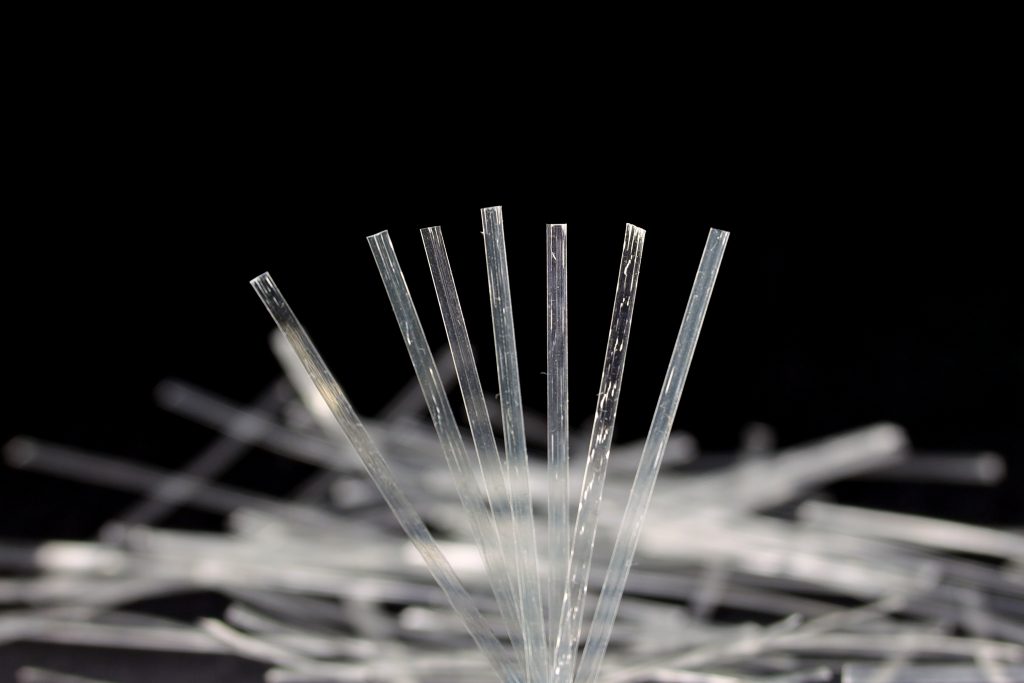
ConFib Macro-48 is a 48 mm polypropylene macro synthetic fiber engineered to replace that sequence: it is dosed into the mixer as a bagged fiber and comes out of the truck as a three-dimensional, homogeneously distributed reinforcement. Per the manufacturer’s TDS, it can be used as primary reinforcement instead of steel mesh and steel wires, and the claimed savings are concrete and boring — reduced application time and labor cost, no mesh handling on site, and reduced rebound on shotcrete work. This article is a specifier’s decision guide: how to read the Macro-48 TDS numbers into a dosage and an application segment.
What the fiber is actually doing: before and after the crack
Fiber-reinforced concrete has two separate jobs, and they are judged at two different moments:
- Before the crack — a high count of stiff fibers dispersed through the matrix ties the concrete together and restrains the shrinkage and settlement micro-cracking that plain slabs develop in their first days. Macro-48’s multidimensional distribution is what the TDS credits for “superior crack control” and minimized plastic shrinkage and settlement cracking.
- After the crack — unreinforced concrete has essentially zero reliable tensile capacity once it cracks. What carries load afterwards is the fiber bridging the crack face. This residual performance is the single most important number class in a macro fiber specification, and it is measured with standard beam tests: ASTM C1609 (third-point loading, reported at defined deflections) or EN 14651 (notched beam, reported as limit of proportionality and residual flexural tensile strengths at defined crack mouth openings). The two methods are not interchangeable — a residual value from one should not be relabeled as a result from the other.
The TDS, read as a decision tool
The manufacturer’s technical data sheet, verbatim values (metric):
| Property | Value |
|---|---|
| Standard | ASTM C1116/C1116M, EN 14889-2 |
| Raw Material | Polypropylene |
| Colour | Natural |
| Density | 0.91 g/cm³ |
| Product Form | Tape Fiber |
| Product Name | Macro-48 |
| Length | 48 mm |
| Equivalent Diameter | 0.46 mm |
| Aspect Ratio | 104 |
| Tensile Strength | 550–600 MPa |
| Modulus of Elasticity | 10 GPa |
| Elongation | 6–8% |
| Fiber Quantity / kg | > 150,000 |
| Ignition Point | 340 °C |
| Melting Point | 140 °C |
| Alkali Resistance | High |
| Acid and Salt Resistance | High |
| Thermal Conductivity | High |
| Electrical Conductivity | Low |
| UV Resistance | High |
| Water Absorption | None |
Three rows in that table do most of the specification work:
- Tensile strength 550–600 MPa at 6–8% elongation, with a 10 GPa modulus. This is the definition of a macro fiber rather than a micro one: stiff and strong enough to bridge a structural crack and carry residual load, not merely to distribute plastic-shrinkage stresses. For comparison of class: micro synthetic fibers are characterized by lower stiffness and are not declared as load-bearing.
- Fiber count > 150,000 per kg. At the TDS’s recommended dosage of 2–6 kg/m³, one cubic metre of concrete carries on the order of 300,000–900,000 fibers (derived from the two published numbers). That count is what makes the reinforcement three-dimensional and homogeneous — the TDS’s own words — rather than a two-dimensional plane of mesh at one depth.
- Packaging in 1.5 kg water-soluble paper bags. The bag dissolves in the mix, so nobody handles loose fiber. At 2–6 kg/m³ the dosing arithmetic is roughly 1.3–4 bags per cubic metre, added at 20–30 second intervals with 5 minutes of mixing after the last bag — a batching-plant or truck-mixer operation, per the TDS.
Geometry: what 104 tells you, and what it does not
Aspect ratio 104 is simply 48 mm / 0.46 mm (the arithmetic checks against the published values). Longer, higher-aspect-ratio fibers anchor better across a crack — but geometry alone does not prove performance in the finished concrete: bond, pull-out behavior, dispersion and orientation all depend on the mix and the application, and fibers of similar dimensions can behave differently depending on material, shape and surface treatment. Practical consequence: use length and aspect ratio to screen a candidate (Macro-48’s 48 mm length suits coarse-aggregate mixes, where the fiber should be of comparable scale to the aggregate), then demand post-crack test data for the actual fiber-mix system — dosage, concrete proportions, test method — before treating the spec sheet as a design result.
Two decisions that pick the dosage and the segment
Decision 1 — Classification. Macro-48 is specified to ASTM C1116/C1116M (the American specification for fiber-reinforced concrete, which classifies by fiber material) and EN 14889-2 (the European polymer-fiber part, which classifies by geometry). Under EN 14889-2, polymer fibers below 0.30 mm equivalent diameter are micro classes (Ia/Ib); Class II covers macro fibers for structural purposes — the class that may be declared as contributing to load-bearing capacity. At 0.46 mm equivalent diameter, Macro-48 sits squarely in that macro geometry, and the TDS positions it as primary reinforcement rather than an additive.
Decision 2 — Segment. The TDS’s own application list defines the segments the product serves; the dosage and the residual-strength requirement are what move within each:
- Slabs on ground and concrete roads — the volume segment. Mesh replacement with 2–6 kg/m³; the dosage is set by the required residual flexural strength, not by habit.
- Shotcrete applications — fiber goes into the mix instead of fixing mesh overhead; the TDS claims reduced rebound, and there is no mesh to hold up.
- Tunnels, coastal structures and composite steel floor decks — the durability segments: high alkali/acid/salt resistance with zero water absorption means the fiber does not corrode, swell or stain the way surface-near steel does.
- Precast and prefabric elements, cement-based composites — crack control through handling, curing and transport, with the fiber count doing the work mesh cannot do in thin sections.
Decision shortcut
- Mesh replacement in a slab, road or deck → Macro-48 at 2–6 kg/m³, dosage set by the required residual flexural strength from a beam test (ASTM C1609 or EN 14651).
- Shotcrete face → Macro-48 where rebound and mesh handling are the cost drivers.
- Wet, aggressive or visible surfaces (coastal, tunnel, pools) → Macro-48 where steel’s corrosion and staining are the objection: PP at 0.91 g/cm³ with high alkali resistance and no water absorption neither rusts nor stains.
Chemistry and site reality
Polypropylene’s chemistry is the quiet argument in the TDS table. Alkali resistance: high — the fiber lives its service life inside a cement matrix with a pH around 13, and unlike glass compositions it is not degraded by that environment. UV resistance: high and water absorption: none — relevant for exposed edges, storage and any section that sees weather. The melting point of 140 °C and ignition point of 340 °C should be noted for fire-relevant specifications (the product is supplied with an SDS covering handling). And because the fiber is polypropylene, a wall or slab face reinforced with it shows no rust staining — the reason fiber selection for visible shotcrete surfaces is a materials question, not just a structural one.
Production and sustainability context
Macro-48 is produced by ANSA Ambalaj (Gaziantep) from 100% virgin polypropylene, under the company’s certified management systems: ISO 9001:2015 (production control), ISO 14001:2015 (environmental aspects) and ISO 50001:2018 (energy management). The sustainability case in use is the steel it replaces: eliminating mesh transport, cutting and handling removes that material flow and its site labor entirely, and polypropylene (resin code 5) is mechanically recyclable at end of life. What the datasheet claims and what the design proves should stay separate — residual-strength test data per mix is the honest bridge between the two.
Before you specify
If you can answer two things — the residual flexural strength your design needs and the segment your element belongs to — the dosage resolves from the 2–6 kg/m³ band and the TDS above. Request the TDS, the SDS and a trial dosage recommendation before you commit a pour:
- Product page: confib.net/products
- Technical Data Sheet (EN): ConFib-Macro-48-TDS-eng.pdf
- SDS (EN): SDS-2025-135EN-PP-Macro-Fiber.pdf
- Contact: info@confib.net — www.confib.net
References
- ConFib. ConFib Macro-48 — Technical Data Sheet (EN). http://confib.net/wp-content/uploads/2025/04/ConFib-Macro-48-TDS-eng.pdf
- ConFib. Products — ConFib Macro-48. https://confib.net/products/
- ConFib. SDS 2025-135 EN — PP Macro Fiber. https://confib.net/wp-content/uploads/2025/06/SDS-2025-135EN-PP-Macro-Fiber.pdf
- ASTM C1116/C1116M, Standard Specification for Fiber-Reinforced Concrete — classification referenced in the Macro-48 TDS; standard summary: Polyguard Fibers, “ASTM C1116 Macro Synthetic Fiber | EN 14889-2 Class II.” https://polyguardfibers.com/standards
- EN 14889-2, Fibres for concrete — Part 2: Polymer fibres — Class I/Class II classification summary: Polyguard Fibers. https://polyguardfibers.com/standards
- Pioneer Fibre. Understanding Residual Performance of Macro Synthetic Fibers. https://www.pioneerfibre.com/post/understanding-residual-performance-of-macro-synthetic-fibers
- Pioneer Fibre. ASTM C1609 vs EN 14651: Why the Results Differ. https://www.pioneerfibre.com/post/astm-c1609-vs-en-14651
- Pioneer Fibre. Concrete Fiber Length and Aspect Ratio: Why Geometry Matters. https://www.pioneerfibre.com/post/concrete-fiber-length-and-aspect-ratio
- American Shotcrete Association. FAQ: Adding fibers to a shotcrete mixture. https://shotcrete.org/faq-items/i-would-like-to-add-fibers-to-a-shotcrete-mixture-many-research-articles-discuss-steel-fibers-and-sometimes-synthetic-id-like-to-consider-glass-or-synthetic-fibers-because-the-exterior-wall/
- ISO 9001:2015; ISO 14001:2015; ISO 50001:2018 — ANSA certified management systems.
This article was prepared by the ANSA Sustainability Unit as a specifier’s decision guide. For comments, corrections, or a technical data request: oguz.cicek@ansaambalaj.com